Why group ergs beat solo ergs
Same workout, same power, different experience. A study of Oxford rowers suggests who is next to you matters.

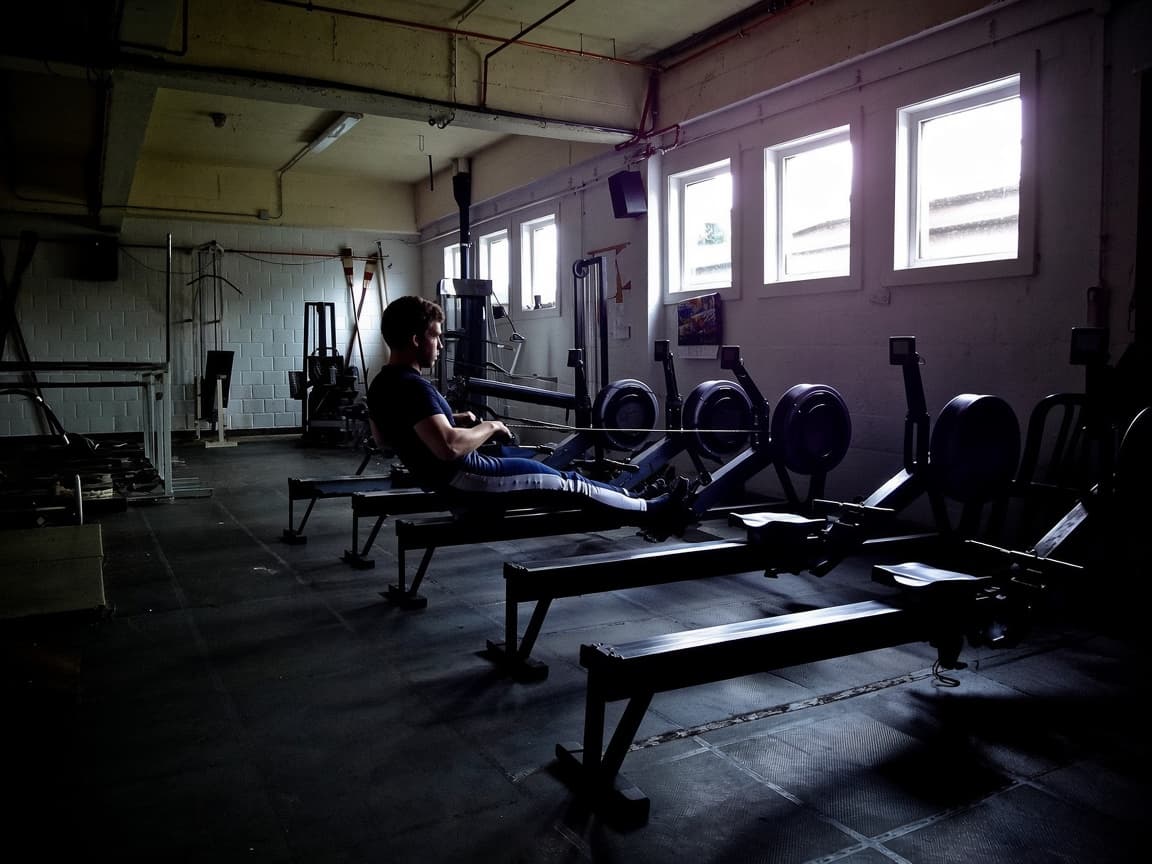
Every rower knows the feeling. A 45-minute piece alone in the corner of the gym is a different animal from the same piece with a row of teammates grinding beside you. Most of us put that down to motivation or distraction. Research from Oxford suggests something more physiological may be going on.
The study
Researchers at Oxford's Institute of Cognitive and Evolutionary Anthropology recruited the Oxford University Boat Club squad. The rowers completed four separate 45-minute erg sessions at the same power output within two weeks, some done alone and some in synchrony with teammates.
The design matters. It was within-subject, so every rower acted as their own control. The researchers also checked for the obvious objections. Power output was not significantly different between the solo and group conditions, so the group could not be credited with simply working harder. The order of the sessions did not explain the result either.
What they found
The researchers measured pain threshold before and after training. Pain threshold rose significantly after the group session compared with the individual one, in both weeks of the study.
Why measure pain? Because it is a conventional, non-invasive stand-in for endorphin release. In the authors' words, synchronized training in a college crew creates a "heightened endorphin surge" compared with similar training alone. Endorphins are the body's natural painkillers, and they are behind the mild "high" many athletes report after hard exercise.
What it does and doesn't tell us
Two points are worth being precise about.
First, endorphins were inferred, not measured. The study used pain threshold as a proxy. The endorphin explanation is the authors' interpretation, and a well-supported one, but it is not a direct blood or brain measurement.
Second, the key ingredient is synchrony, not just company. The group condition had rowers moving in time together. Dr Emma Cohen, the lead author, has since noted that the effects of social support may be signalled in many ways, not only through synchrony. So the study supports "rowing in time with others", not necessarily "any group setting".
What it means for your training
The practical lesson is a modest one, and a useful one.
For your hardest pieces, pair up. Set up next to a teammate, match rate, and hold the piece together.
Treat solo sessions as a choice, not a default. Alone is fine for steady state. For a gruelling 45-minute grind, the evidence leans towards the squad.
Remember it's a small study. It involved one elite squad, so treat it as a strong signal rather than a law of nature.
The takeaway for coaches and clubs is that the erg room is not just a place where fitness is built. Doing it together may change how hard efforts feel.
Source: Cohen EEA, Ejsmond-Frey R, Knight N, Dunbar RIM. Rowers' high: behavioural synchrony is correlated with elevated pain thresholds. Biology Letters. 2010;6(1):106-108.